Today in my English class, my teacher and I discussed how to build healthy relationships with people close to us.
This is a huge topic. I tried to use all the phrases and vocabulary I know to explain my thoughts, while also giving as many examples as possible to make the ideas easier to convey. After all, I am using a foreign language, not my native tongue.
With such a big topic, I truly don’t know where to start.
So, I will just start by sharing whatever comes to mind. Let me pick the smallest sub-topic to open with:
The Definition of a Conflict (爭執)
My definition of a conflict is: A disagreement or clash that occurs when two or more people have different views or opinions on the same matter, and each person insists on their own perspective or position, leading to an impasse, disagreement, or even open confrontation.
When a conflict occurs, people often inadvertently criticize or attack the other person’s differing viewpoint. When they receive these less-than-friendly remarks, most people tend to “shift into an angry state,” the topic gradually loses focus, and the exchange ultimately devolves into a spat driven by personal pride, ending in bitterness.
Naturally, the depth of the negative emotions or relational damage caused by a conflict depends on each person’s personality and attitude toward the issue. Some people, even in the midst of a disagreement, can remain clear-headed, recognize the goal, and avoid losing themselves in the argument. Conversely, others, due to their over-insistence on their own opinion, fail to reach a consensus, which not only damages the relationship but also prevents a positive resolution to the original issue.
The Window Curtain Example
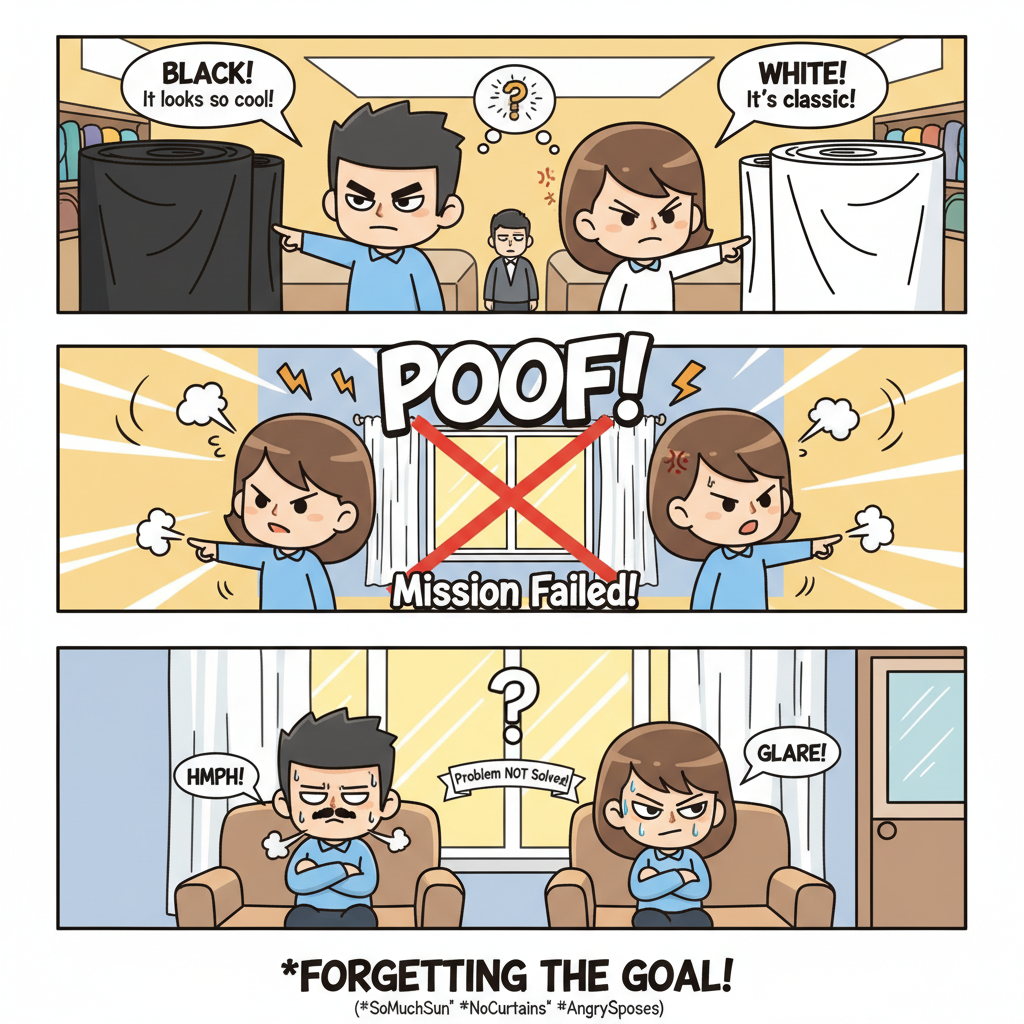
For instance, consider the Wang family couple. A window in their home receives intense sun exposure, so they decide to buy new curtains. They go together to choose a suitable color. Mr. Wang says black looks better; Mrs. Wang insists white looks better. They argue endlessly. In the end, they don’t buy the curtains, they have a big fight, they return home to continue baking in the sun, and Mr. Wang is left fuming while Mrs. Wang glares.
It’s a small, seemingly simple matter, yet this kind of problem genuinely troubles many people. When they communicate with others and don’t get the answer they want, they often fall into disputes or arguments. This isn’t necessarily anyone’s fault. It’s like Mr. Wang saying black looks good—he’s not wrong. Mrs. Wang saying white looks good—she’s also right. In this situation, there is no absolute right or wrong, only a question of who is willing to yield, or whether they can jointly decide on a third color to replace black and white.
The point is, during their argument, they forgot the original purpose of buying the curtains. If they could step out of the “black vs. white” mindset, in most cases (barring exceptions), I believe they could find a color they both accept. Wouldn’t that solve the sun exposure problem?
How to Resolve Conflicts
An endless argument is never a solo act; everyone in that circle is a key player. As long as one party refuses to back down from their opinion, a conflict is likely to occur.
Yielding (退讓) is the key. Yielding is not a sign of weakness, nor is it an indirect admission that your own view is wrong.
Let’s use the “buying curtains” example again.
When the Wang couple first discussed the color, they could each propose their favorite. But upon hearing the partner’s chosen color is not what they prefer, they should not immediately criticize the color as ugly or add extra negative comments, attacking the partner’s taste and insisting their own aesthetic is superior.
Mr. or Mrs. Wang should first affirm or support the partner’s idea immediately, and only then state their own thought. For example:
- Mrs. Wang: “I think white curtains look nice.”
- Mr. Wang (First expresses support to effectively reduce the risk of falling into conflict): “Hmm… White certainly does look nice… However… (Pauses for a few seconds, scratches his head, speaks in a calm, steady voice)… But white feels like it… would get dirty more easily!”
- Mrs. Wang (Because she wasn’t initially rejected by Mr. Wang, her emotion is more stable and she is more receptive to his criticism): “That’s true! White definitely shows dust and stains easily!”
- Mr. Wang: “I think black looks good!” (Mr. Wang remembers that saying this is not a conclusion, but an invitation for Mrs. Wang’s opinion, making her feel respected.) He then adds, “What do you think?” (Making Mrs. Wang feel her opinion is important and valued.)
This constitutes a more rational communication style, especially for issues without absolute right or wrong.
- Mrs. Wang: “Black does look nice!” (Mr. Wang receives a positive response from Mrs. Wang, so his mood naturally remains stable and he is ready to listen to her next point.) / (Then Mrs. Wang also scratches her head, thinks, and slowly says…) “But, black lets in less light. If we draw the curtains during the day, the room won’t be bright enough! Plus, black seems to absorb more heat. It blocks the sun, but it keeps the heat inside the house!”
At this point, though they proposed different colors, they have firmly and respectfully pointed out the flaws in each other’s color choices. This avoids hurting the partner while acknowledging the shortcomings of their own preferred color or view. It softens their respective positions, removing the sharp edge of confrontation and averting an argument.
Afterward, whatever the result—buying black, buying white, switching to another color, deciding not to buy any and continuing to sunbathe, or even boarding up the window so curtains are never needed—they have avoided a pointless war of words.
My Central Idea: The Power of Acceptance
Actually, the central idea I most want to express is:
- Whenever we receive a message or feedback that is not what we expected, the immediate first psychological or physiological response should only be “Acceptance or Acknowledgment.”
- “Acceptance or Acknowledgment” belongs to a state of “Mindfulness” or “Positive Emotion.” Having this emotion prevents us from sinking into the quicksand of negative feelings.
- “Acceptance or Acknowledgment” allows our mind to be calmer and enables a more rational and methodical analysis of the core issue or details, making it easier to see the whole picture of the event.
- “Acceptance or Acknowledgment,” similar to the “yielding” I mentioned above, is not a display of weakness. Instead, it is a preliminary strategy that helps solidify one’s own position. One must be “clear” (清 qīng) before one can be “wise/perceptive” (明 míng). Ultimately, it makes it more likely to find a suitable path forward together.
Alright! It’s too late! Time to rest! I’ll write more next time I have a chance!
That concludes my post-class reflections for tonight. Original by RIO(Old Otaku) & (translate by AI).
 我的中文原文

今天的英文課,我和老師共同討論了關於如何和自己親近的人建立起良善的關係。

這是一個很大的話題。我嘗試使用所有我已會的隻字片語來解釋我的想法,同時也盡可能列舉一些例子,讓想法能夠更容易的被傳達。
畢竟,我使用的是外語,而非我的母語。

這麼大的議題,真不知道該從何開始?
所以,我現在就是以「想到甚麼就說甚麼」來開始吧。就挑一個最小的話題來開場吧。

 爭執

我的定義是:兩人或多人對相同的一件事物有著不同的看法或想法,而彼此都堅持自己的意見或立場,從而無法得到結果而產生意見上的不合、甚至衝突。
當爭執發生的時候,人往往容易在不經意之間,針對對方與自己不同的論點進行某種程度的批判或是攻擊,當接受到這些不似友善的言論時,大多數的人都會傾向於「轉發怒狀態」,然後話題漸漸失焦,最終淪為意氣之爭,不歡而散。

當然,因為爭執所帶來的負面情緒、或是對人際關係的影響,其程度深淺,端視於每個人的個性或是對事的觀念。有些人,雖處在爭執當中,但始終能保持清醒,認清目標,不至於在爭論過程中迷失自己;反之,有些人則會因為過於堅持己見,最後未能達成共識,除了傷害了彼此的關係之外,也讓事情沒有一個該有的好結果。

舉例來說,王家夫婦家裡的一扇窗,因陽光日曬情形嚴重,因此決定要添購新窗簾。兩人一起去挑選合適的顏色,王夫說黑色比較好看、王婦說白色才好看,倆倆爭論不休,最後窗簾沒買成,還吵了一架,回家兩人繼續在家曬太陽,然後王夫在那吹鬍子、王婦在那瞪眼。

一件小事,看似簡單容易,這樣的問題卻紮紮實實困擾了很多人。他們往往在和他人溝通,達不到自己想要的答案之時,容易陷入爭執、爭吵,其實這也不是誰的錯。

好似是王夫說黑色好看,沒錯啊;王婦說白色好看,也對啊。

這種沒有「絕對的對與錯」,只有「誰願意退讓」,或是「共同決定」出第三色出來替代黑色與白色。總之,他們在爭執過程當中,已經忘了當初要買窗簾的原始目的,如果可以跳出黑色與白色的思維,絕大多數情況 (無特例時),相信他們應該可以找到一種彼此都能接受的顏色。這樣不就解決日曬的問題了嗎?

 如何化解爭執

爭論不休,絕對不是單一一個人的事情,在這個集合圈子裡,每個人都是關鍵人物。只要有任何一方不棄己見,那爭執就容易發生。

退讓——從不是「示弱」的表現、更不是另類的表示自己的觀點是錯誤的。

同以此上「買窗簾」為例:

王家夫婦在一開始討論窗簾顏色時,可以先各自提出自已喜歡的顏色。但當聽到對方所選的顏色並不是自己喜歡的顏色時,不要直接批評該色難看、或是額外增加種種負面的批判,指責對方的眼光不好,堅持自己審美觀念的才適合。
王夫或王婦可以在第一時間聽到對方的想法時,先給予肯定或支持,接下來再說出自己的認為的想法,例如:

王婦:「我覺得白色窗簾好看。」

王夫(先表示支持王婦的意見,有效降低落入爭執的風險):「恩... 白色確實好看... 不過...」(停頓幾秒鐘,摸頭想想,平穩口氣...緩慢答道),「痾... 可是白色感覺....比較...容易髒呢!」

王婦(因一開始沒被王夫拒絕,所以當下情緒是比較穩定的,也就比較能接受王夫說的缺點)回答道:「對啊! 白色確實一沾灰塵汙點,就容易被看出來!」

王夫:「我覺得黑色好看啊!」(記得:王夫說這句話並不是結論,而是徵求對方王婦的意見,讓王婦能感受到被尊重。)...隨後再加一句「你覺得呢?」(讓王婦覺得自己的意見也很重要,有被重視的感覺。)

 這就屬於比較理性的溝通,特別是在這種沒有絕對的對與錯的事物上面。

王婦:「黑色也確實好看!」(王夫也得到王婦正面的回應,情緒自然能比較穩定,聆聽後面的意見)...(然後王婦一樣摸摸頭、想想... 緩慢說道)...「可是,黑色比較不透光呢,這樣當白天拉上窗簾的時候,室內光線反而不夠亮呢!! 而且黑色似乎更容易吸熱,雖擋住的陽光,卻把熱度留在家裏面啊!!」

================

至此,二人雖提出的顏色需求不同,但也對於對方的顏色缺點牢牢實實的說了出來,既不會傷害到對方,又能認識原來自己所挑的顏色或觀點也有欠缺之處。同而柔化了彼此的立場,不再堅刃相對,免除了一場爭執。
接下來,無論結果為何,買黑色窗簾也好,買白色窗簾也罷、甚至換買其他顏色、或乾脆不買繼續曬、又或乾脆把窗戶用木板封起來永遠不需要買窗簾...等等,總之就是免去了一場無謂的口舌之爭。

其實,我最想要表達的中心思想是:
1. 每當我們接受到一個並非自己所期待的訊息或是回饋之時,當下的第一個心理或生理反應,都只有「接受或是接納」。
2.「接受或是接納」是屬於一種「正念」、或說是「正向情緒」,有了這種情緒,便不會落入負面情緒的泥沼中。
3.「接受或是接納」,可讓自己的心念更加冷靜、可以比較理性、有條理的分析事情的癥結或是細節,更容易看清事件的全貌。
4.「接受或是接納」,同上面我所說的「退讓」相同,都不是「示弱」的表現。而是把自己立場踩得更加明確的一種先頭策略。先能「清」、後才「明」。最後也比較可能找出一條適合的道路共同前進。

好啦!!時間太晚了!!該休息了!!下次有機會再來寫吧!!

以上就是我㋡老神宅宅♡今晚的課後感想文。